Criticisms
In Pursuit of 'Invisible Space'
2002
Youngpaik Chun | Art Critic, Professor, Department of Art Studies, Hongik University
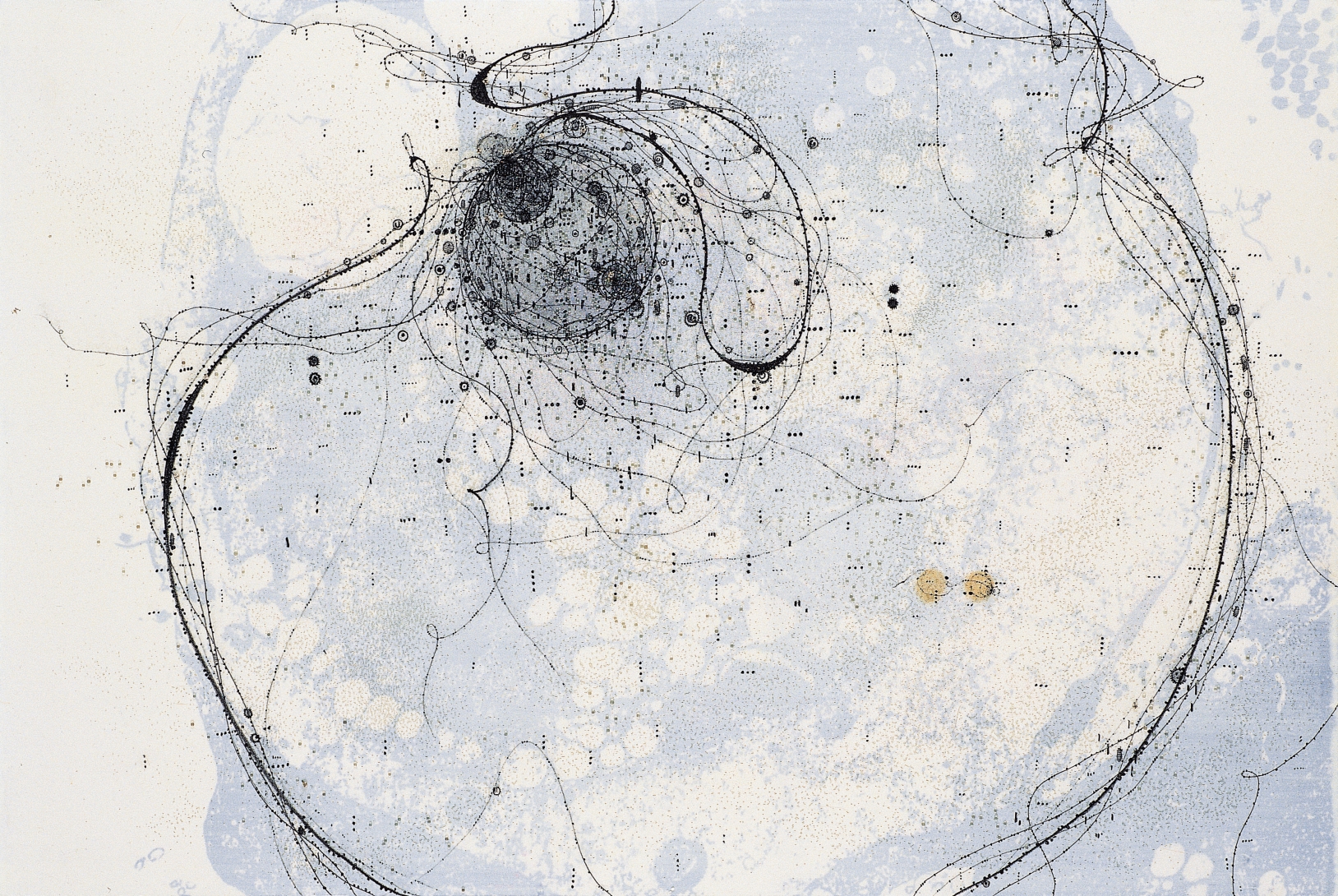
〈Invisible Space - 02102〉, 2002, 캔버스에 혼합매체, 61 x 97 cm ©Artist
It is a special moment to write the forward to an artist’s very first exhibition. It feels like giving a newborn child its name, while at the same time being a mediator in the sense of presenting the artist’s works to the world for the first time by interpreting their visual images in words. As there are no existing references, it allows the writer to have a free hand, yet the responsibility is also heavy.
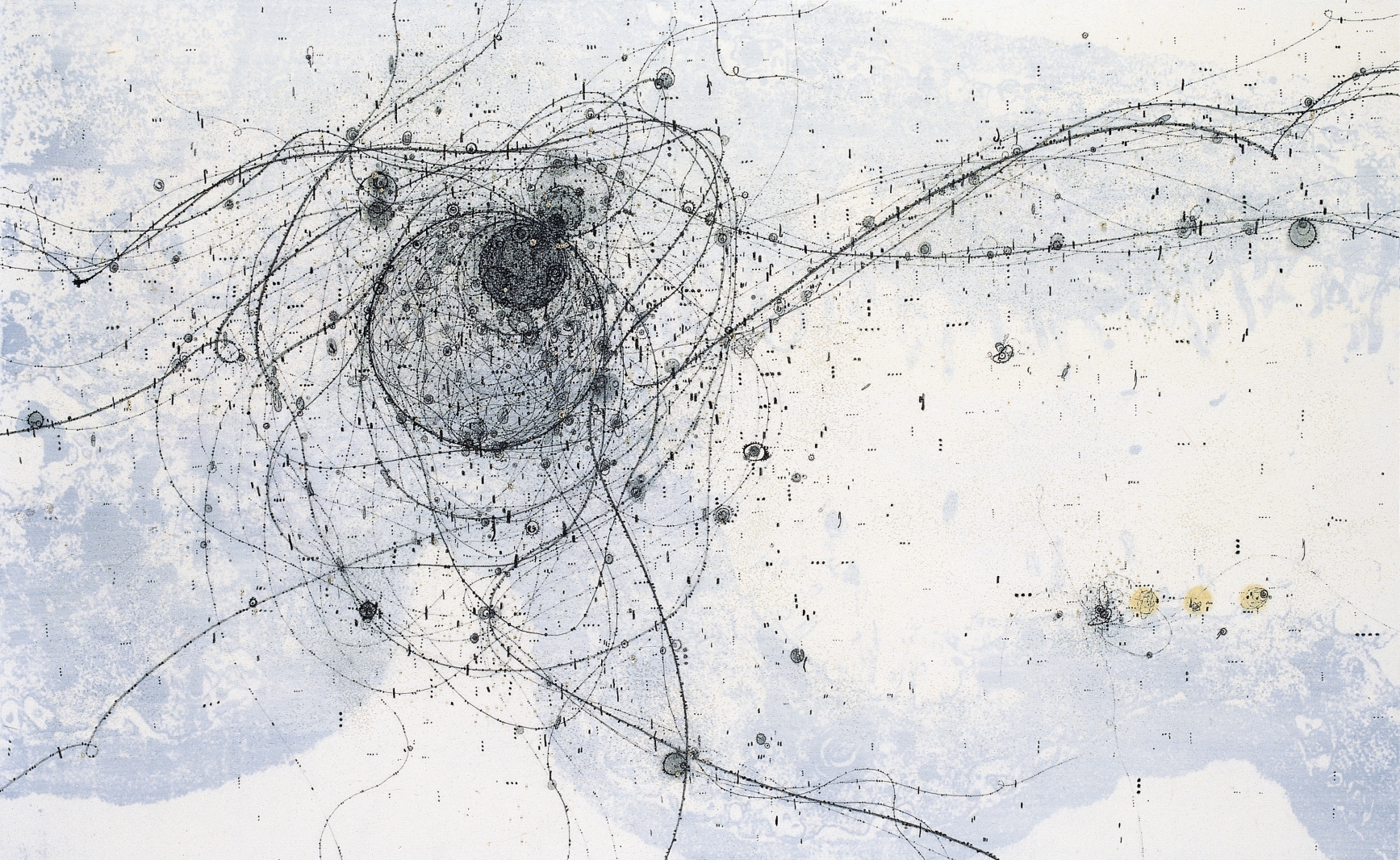
It was in 1999 that Kangwook Lee started his first paintings with the motif of 'cells' which give the illusion of observing cellular tissue and the nervous system through a microscope. He was fascinated by the conceptual idea of cells. Living things are composed of a whole unit of many cells. However, synthesizing each fragment does not create a unified entity. Therefore, the fact that the whole is more than just a composition of fragments attracted Lee to cellular tissue and nervous systems. This relationship between a single unit and the whole is also applied as a microscopic language in pursuit of himself.
It can be said that the whole is 'myself' and each fragment is the finest part that constructs myself. Thus, narrowing the visual gap between the viewer (the subject) and the drawn object is in fact a matter of how much one can get close to oneself. If the thought has come this far, an anatomical chart in a science lab that had nothing to do with oneself becomes a personal topographical map of one’s own body that one cannot actually see through. One is led into the microcosm of the internal space which one could not see before.
Since the 1970s when the issues around the human body first arose, we have been frequently exposed to a range of bodily involvement in the contemporary art scene. However, Lee’s approach to the body and sight is quite uncommon here. As a matter of fact, when it comes to the world of cells, the differences between people are only trivial. In terms of the absolute reliability of an individual's identity based on discrimination by sight, the classifications of race, gender and personal character are hopelessly unified under the microscope. In the same way, a classification of cells is equally meaningless as they are either living or dead.
Lee's paintings fix genuine images on the pictorial surface via plating many thin layers of gel medium and binder on his organic drawing works painted with gouache, and this process appears to be similar to the procedure of molding hot amorphous objects or attaching them with glass or chemicals. When the image is safely fixed through the layered membranes, it is instantly captured and permanently fixed due to the extremely high surface tension. The surface of the painting is excessively slick delivering a chilly atmosphere akin to that of a hospital. The instant adherences of living things remind us of the subtle boundary of a movement and a pause, life and death, and the instant process of capturing living things on the surface seems to reflect the will to make everlasting vividness. It is reminiscent of the ecstatic moment we experience on viewing Pompeii's mural paintings or dinosaur fossils which originates from witnessing the very moment of an instant freezing of time.
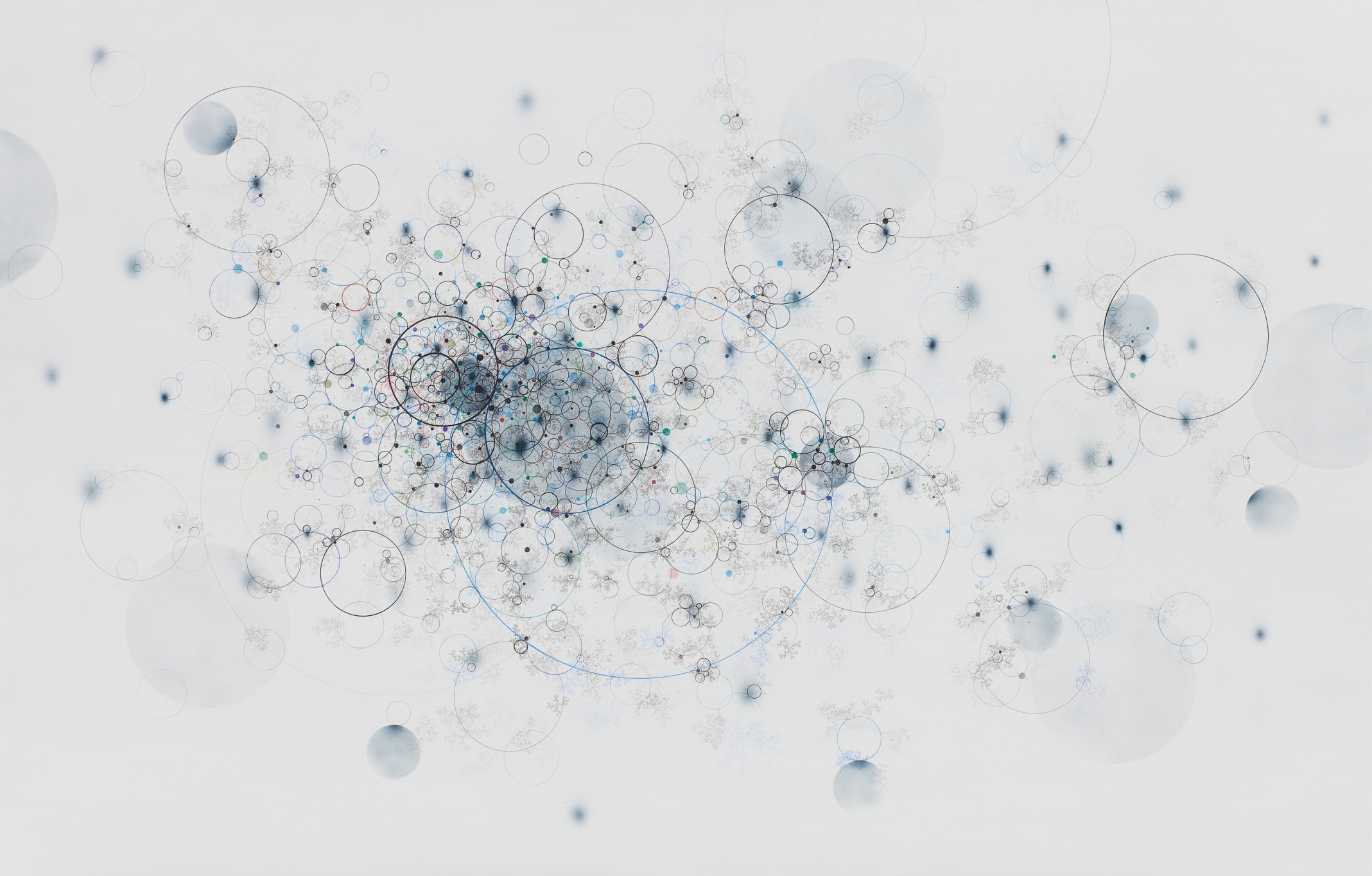
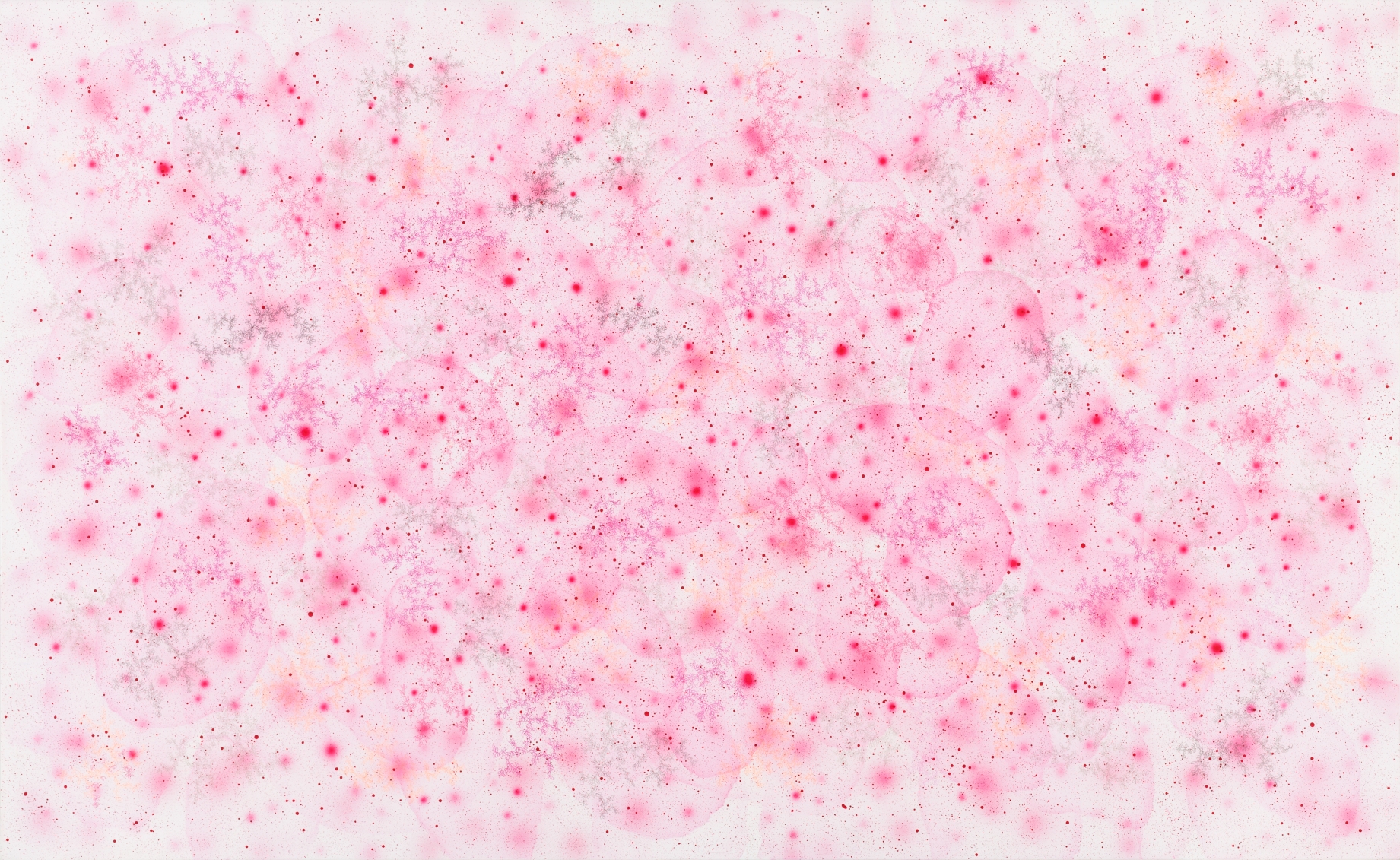
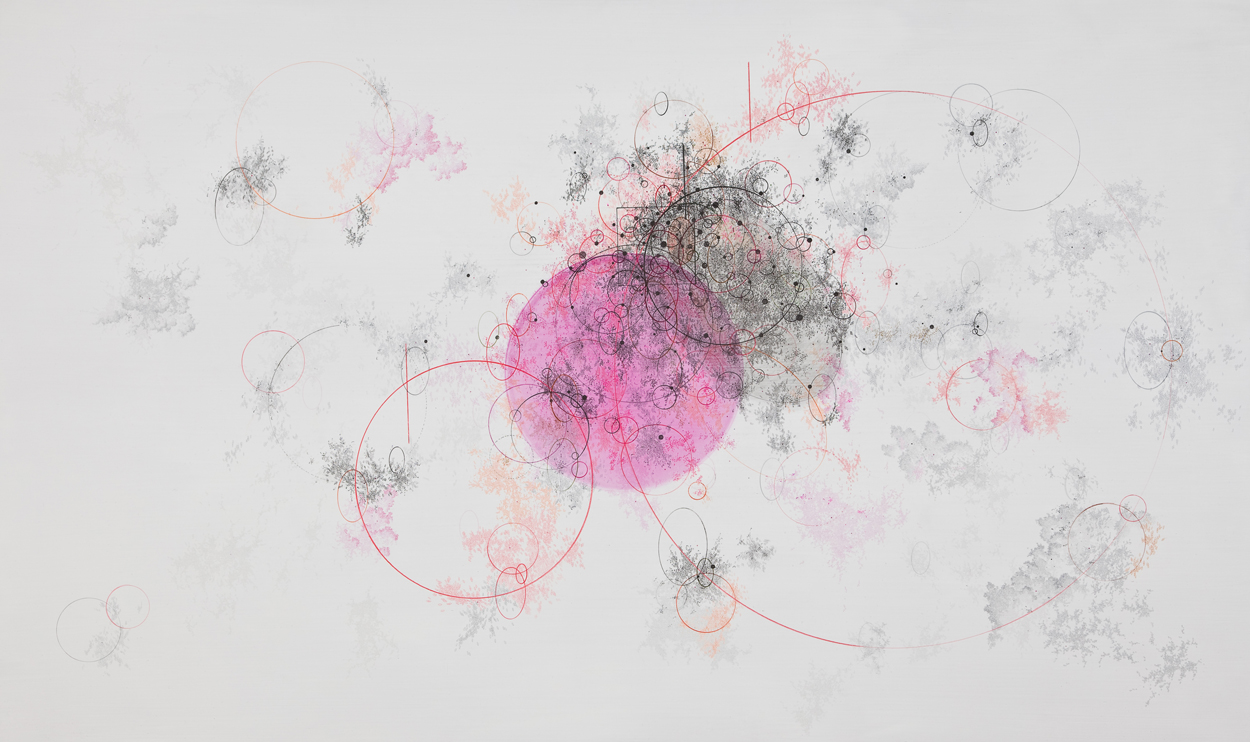
In his recent abstract works, the contiguity of vision has become more intense and the surface handling, with its overlapping layers, maximizes the slickness of the painted surfaces more than his early hyper-realistic works. The minimum distance from which one can observe the form of objects is now lost. Rather, one can see the smallest floating particles such as blood cells and DNA which our common sense, based on sight, can hardly comprehend in his paintings.
The scene where many minute particles that have a strong inner vitality break the boundaries, and then float upon the surface of our vision like flower seeds, seems to contain a paradoxical and dynamic – almost brutal – energy. Is it the minimum limit of energy that each discernable cell unit can carry? It is impossible indeed to set the scope of vision to 'minimum' just as it is for 'maximum'? In the sense of infinity, both ends must meet at the end. However, Lee's works start from the former, the concept of minimum. I stare at his recent abstract works thinking, 'how much further can he go?'
His abstract paintings should be understood not as in the nature of abstract art, but in the stream of narrowing down the view and the process of contiguity. To catch his thought, one needs to draw a clue from the biological map of the body which he referred to at the beginning. Although we will have to wait and see, the possibility of whether or not the breathing of these minute lives can be visualized intrigues me.
Lee's paintings begin with the presumption of spotlighting the most minute part of the infinite inner world. An organic linkage of a neuron system cannot be regulated with a definite frame or a limited visual rectangle, but stretches out to all directions across the border. Thus the painting incorporating this sophisticated network is partial in contents and it specifies the inference that itself cannot be the whole.
Consequently, his paintings imply the infinite invisible world of being complicatedly interwoven, which the pictorial surface cannot fully contain. Both the knowledge of 'myself' and the scope of sight shown in the picture frame are just a portion of the whole. However, his mysterious paintings demonstrate his curiosity about and his respect for the invisible world. The extent of sight becomes narrow as I come close and I become new to myself as I reveal myself.
The pursuit of oneself is the prerequisite of all artists. Especially today among diverse art genres, artists expose or sometimes even attack themselves with daring languages. For example, Mona Hatoum showed the very inner part of our bodies by endoscoping herself in an attempt to face ‘me in myself’, shock and create a sense of the uncanny. However, such western languages that are expressed as 'abject art' might seem excessively offensive in other cultures. Artists with this tendency sometimes create an impression of awkwardness rather like non-native speakers attempting to speak a foreign language fluently. However, Lee's paintings do not cause this sort of awkwardness or antipathy.
I imagine a trip within myself as being like an invitation to the world of microcosm which requires a long time and visual concentration. It is certainly a different experience compared to today's other art galleries where shock overwhelms the value of beauty. Lee's painting style is both graceful and gentle, while those 'drastic' paintings excessively concentrate on shock value and turn one’s vulnerability inside out. Although people often say that one needs to be crafty in order to survive in this world, his canvases provide me with comfort and self-discipline. Because the inner body, regarded as an 'invisible space' by the artist, can only be thoroughly observed in a peaceful moment.
Lee's exhibition is different from those of earlier artists which radiate the typical style of emptiness towards the world. To overlook this impression of the ordinary purity of a rising artist's first exhibition does not seem right. Remembering that flatness is the basic principle of modernist painting, our sight does not stay at one point but rather we are constantly scanning the pictorial plane.
Lee's works could be the final stage of this flatness that our eyes can accomplish to reach the furthest point by means of observing things scrupulously. The new must be like the new. His ways of appreciating an infinite world through the minute part of his inner self, rather than through the external features of the surroundings, are fuelled by his persistent humility with genuine curiosity, and it is the optical approach that seems lacking in our contemporary eyes.
In a world in which the word ‘honesty’ has become stale, Lee's exhibition represents an honest search for the world through myself which takes place silently. Let's get rid of all this noise just for a moment and turn our gaze on the exhibition.
Writings