Criticisms
Paradoxical Space: The New World-The Storied Space of New Abstract Painting
2016
Yeon Shim Chung
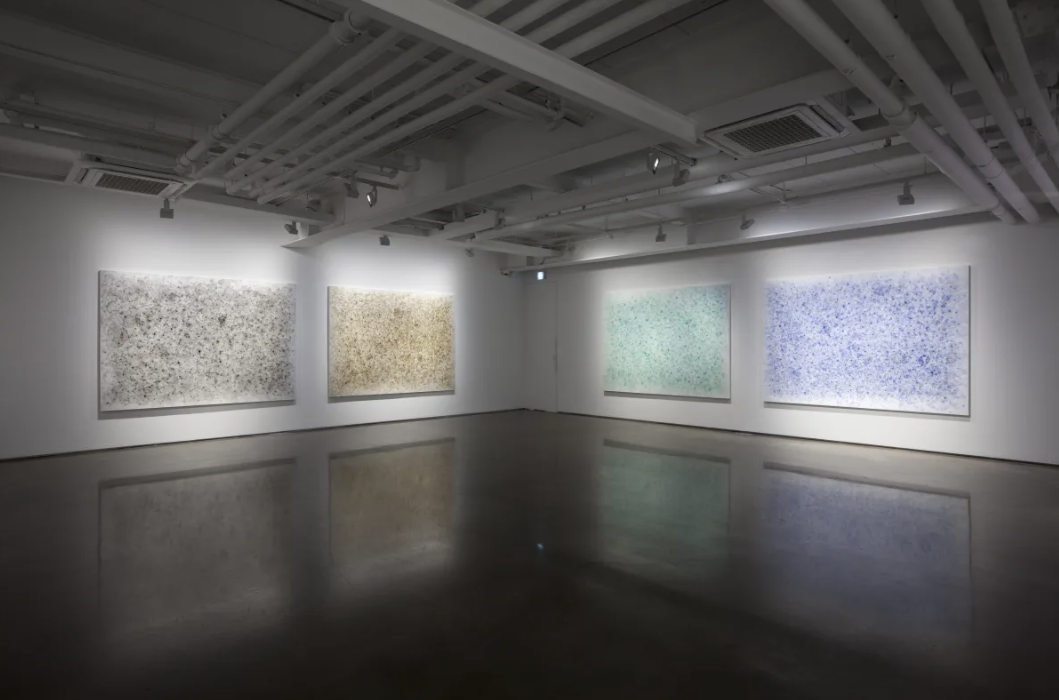
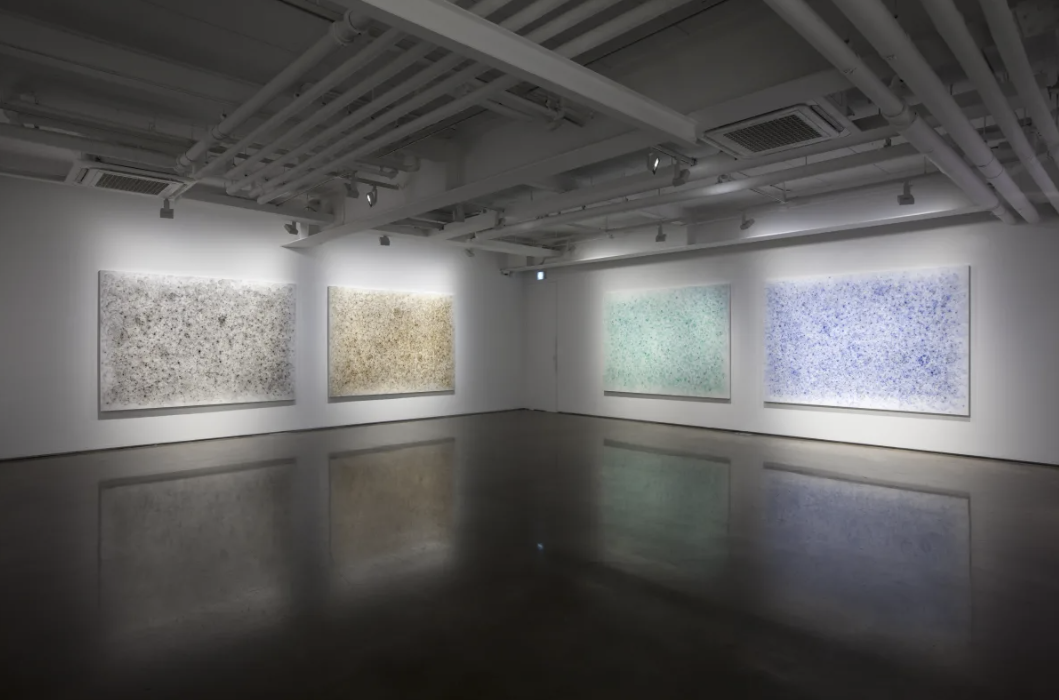
Installation view of《Paradoxical Space: The New World》©ARARIO GALLERY
I.
Lee Kang Wook had studied painting in Korea and the United Kingdom and has been presenting about 10 solo exhibitions in Korea and abroad. He traveled to the United Kingdom in 2008 and since then, he began his career as an international artist based in London. Lee mostly used the title《Invisible Space》for his recent solo exhibitions at Tokyo Gallery in Japan or Singapore, and also used《Minimum vs. Maximum》in 2014. Such titles are not chosen coincidentally, but they play the role as a ‘directive’ or a ‘signal’, speaking to the audience. After quite some time working as an artist based in the UK, he presents a new solo exhibition in Korea titled,《Paradoxical Space: The New World》.
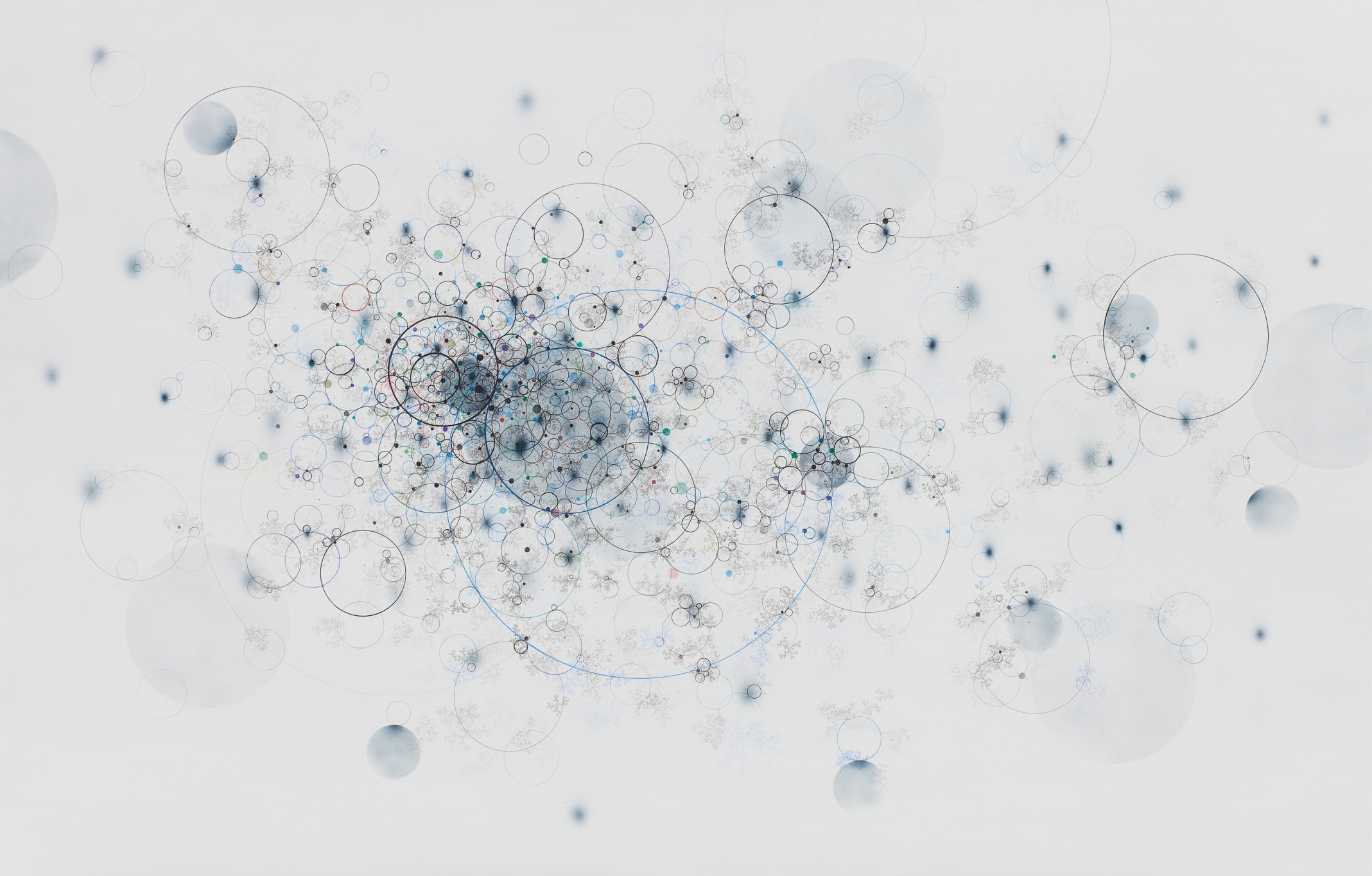
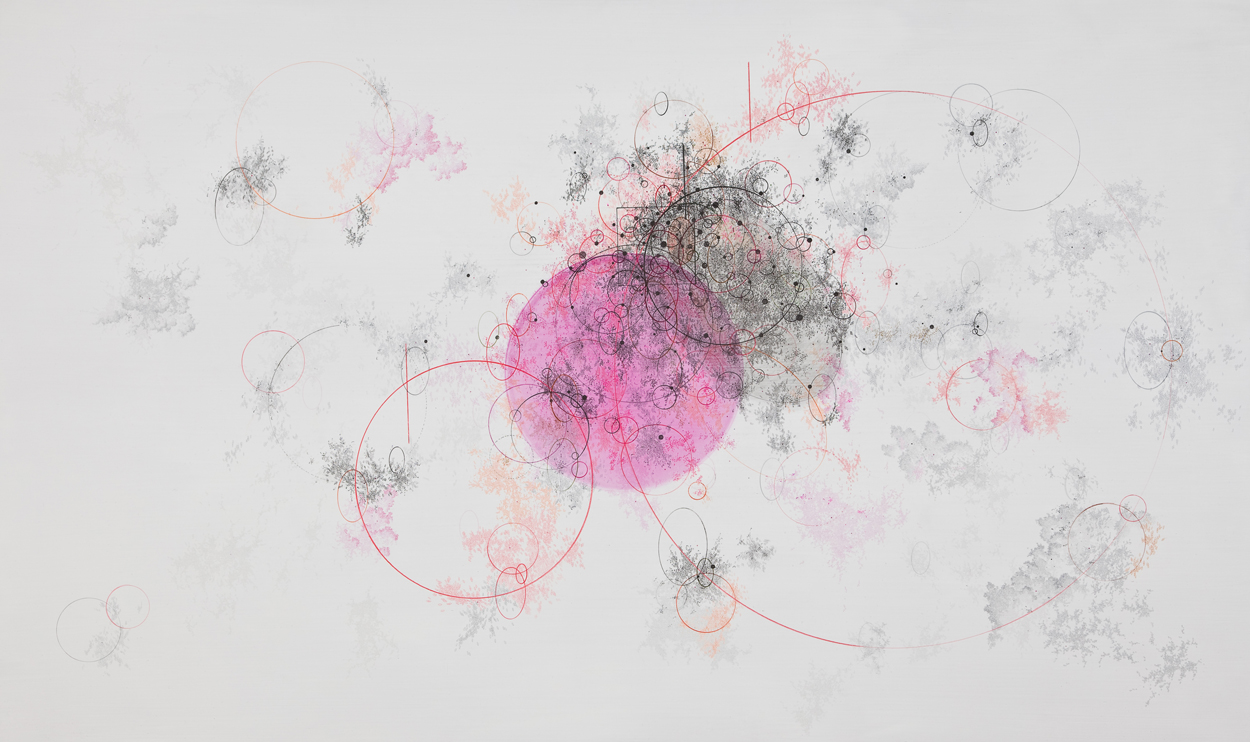
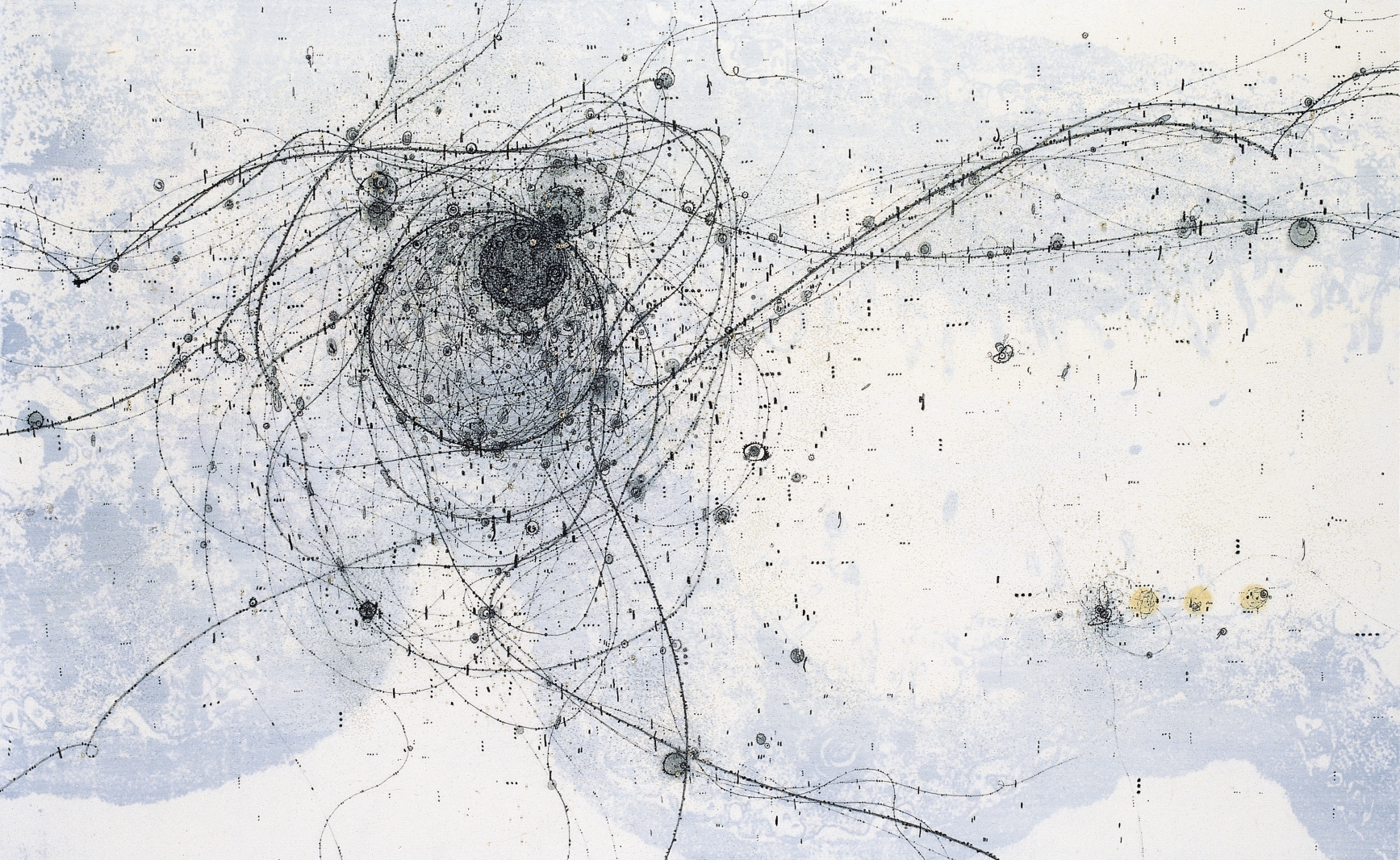
In the early working stages, Lee Kang Wook focused on the difference and crevice of the macroscopic and microscopic view of certain image. Lee gradually began to deal with cells and nervous system, invisible to the naked eye and the form on his canvas grew to hold organic network. The respective appearance continues on to ‘Paradoxical Space’ shown at Arario Gallery. The geometrical forms in various sizes smoothly develop into the organic surface.
As Lee moved his base to London, his interest went beyond the cell tissue system of the human body and further extended to the ancient Indian philosophy of Upanishad. This philosophy concentrates on the harmony between Brahman, the universal permanent world and Atman, the temporal and variable world. It emphasizes that these two worlds are not separate domain but ‘one’, creating the part and the whole together. As Lee absorbed the Upanishad philosophy, he seems to have realized that the ‘contradictory notion’ of the maximal and minimal concepts, which composes the universe, exists within the pictorial frame of the canvas or in our daily lives.
Lee Kang Wook’s new space, in other words, the new abstraction appears to raise a question to the ontology of painting in the post-medium era. The most fundamental geometrical form that composes the painting creates ‘oneness’ with the numerous tones, which seem temporarily afloat. The whole and the part become organically connected and the Upanishad Lee had indulged in, is told in one through the lines and tones on canvas in the world of painting.
His paintings, produced through such procedure have become the vessel to hold the cause, and the thinking process has embodied the work within the ‘painting’ process like a record. The word, ‘paradox’ itself includes opposite concept or characteristics and Lee Kang Wook’s ‘Paradoxical Space’ is the organic ‘new space’ of flow, where gaps are fallen and boundaries are vanished without binary oppositional phenomenon of the object and dichotomous structure of visual languages. The layered structure, building endless network with the current of multiple lines, exists as the trace of ‘reference’ as in Lee’s words or a gesture.
Though Lee takes the basic form of the abstract painting in his work, he does not pay attention to the ‘reductive’ visual language, which abstract modernist painters pursued. Because his abstract language creates complex stratum, overlapped with number of layers, escaping the effect of flat surface. Moreover, he leaves ‘decorative’ traces in his work. What could this signify? The word ‘decorative’ is completely contrary to the usual monochrome abstract painting method of revealing profundity with heavy atmosphere. This accompanies light and ‘bling bling’ effect. In addition, the expression, ‘decorative’ exceeds the material significance of the decorating effect that Lee actually uses.
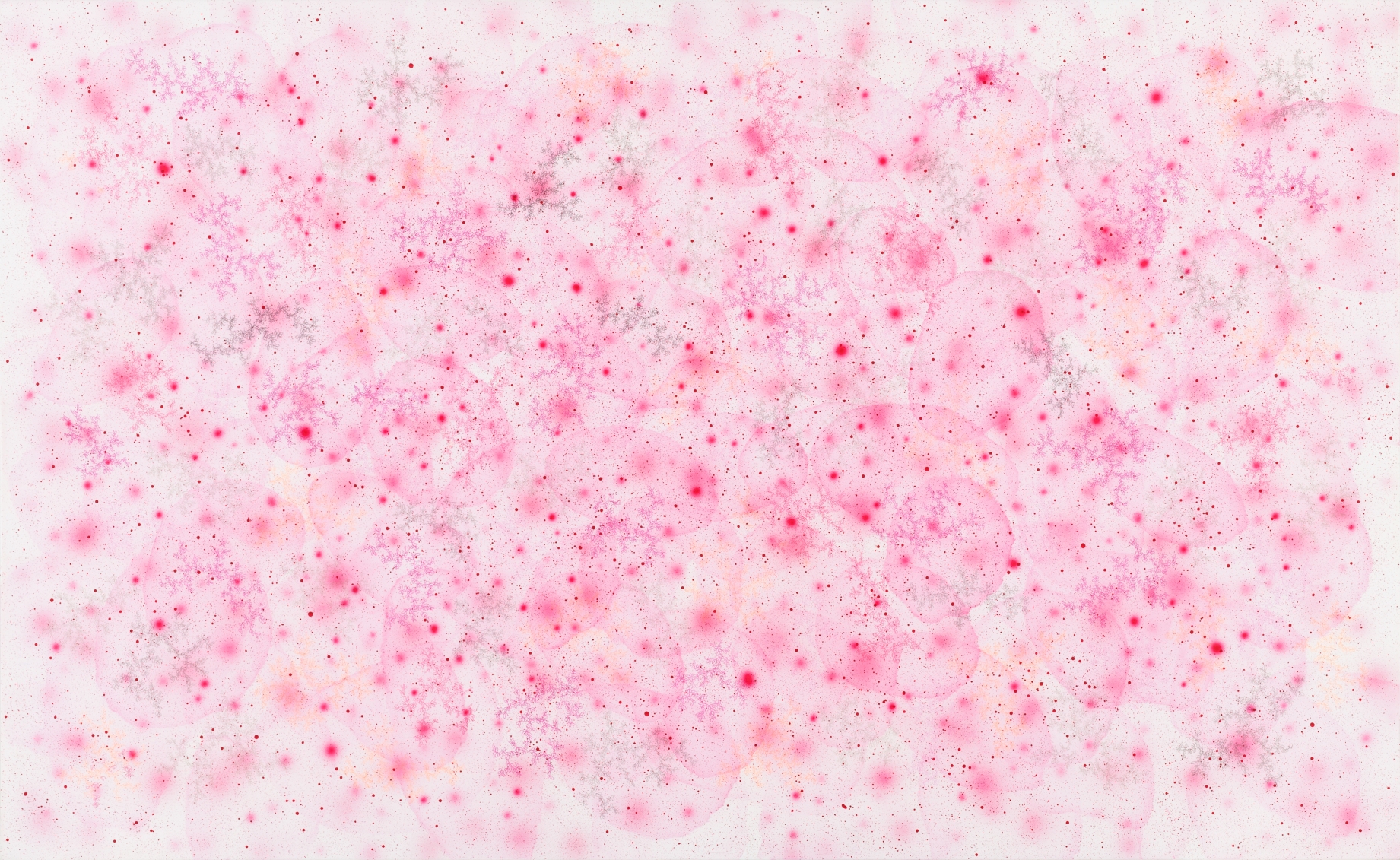
These signify the ‘sparkling’ cultural code of today found in the popular culture or felt from the smart phone chatting or chit-chat overheard in the streets. The floating lines are delicate yet intense, far from ruggedness or heaviness. Besides, the sparkling surface of the painting not only affects the visual perception but also arouses different reactions from the audience, depending the lighting positions. Paintings with such effects bring imaginary images of the falling stars or the celestial universe, apart from its compositional method of point, line and surface. This makes the painting into a space of warmth, delicacy or ambiguity. Through this, his paintings extend outside the physical space using various sizes and here, ‘imagination’ comes forward. The sparkling space is the space of virtual fantasy, making our logic and rationality slip within.
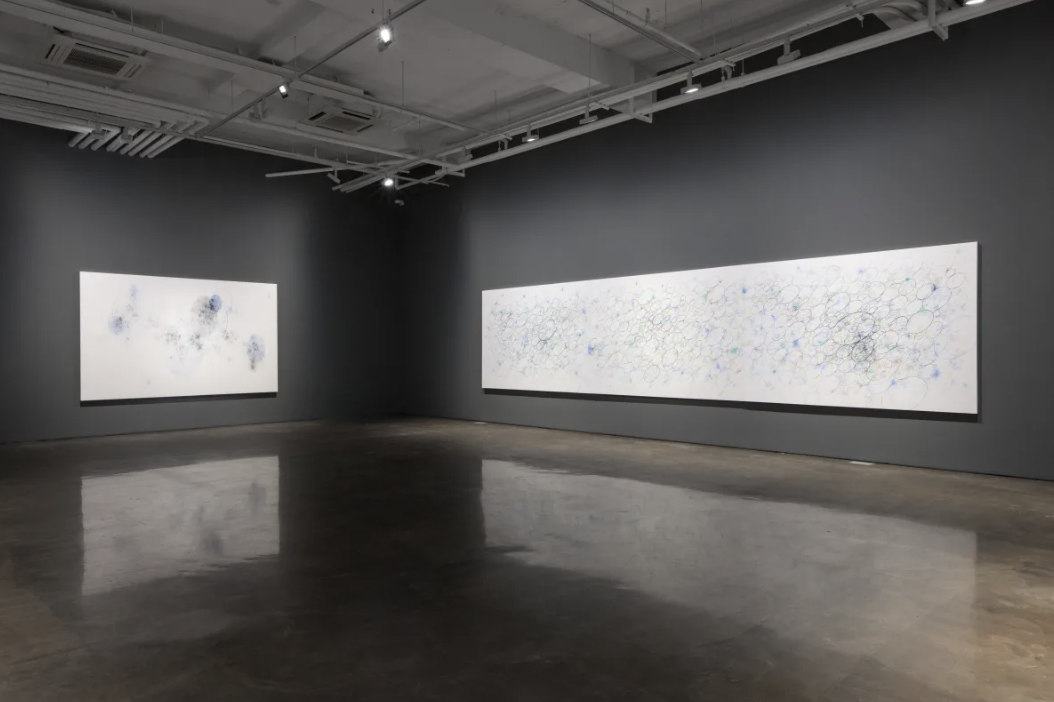
Installation view of《Paradoxical Space: The New World》©ARARIO GALLERY
II.
Lee Kang Wook actually uses sparkling mixed media on canvas and attempts variation of the color palette to create diverse tones. The variety of tones in circular shape creates ‘illusory’ space leading to an infinite-like space. The space with layered tones narrates the artist’s movement and story with linear drawings and tone rather than the color schemes. This maximizes the aura and the atmosphere of the work. His work seems like a labor-intensive miniature painting or a perfect abstract painting from the outside, but it is in fact, the world of new abstract painting that looks ‘like abstract painting’. Here, a story always follows after. This is contrary to the historical context where most abstract painters deleted stories for the purpose of ‘exclusion of the subject’.
The former abstract painters had been very sparing with portraying their work with spatial narrative. They want us to feel the sensation with the resonance of line or to psychologically feel the sublimity of color. It is also difficult for audience to discover a story within an abstract painting, unless it is a conceptual painting with a narrative. Apart from such context, a particular characteristic is found in Lee’s abstract painting. For example, I was continuously listening to Lee when I visited his studio in early December. Consequently, the new abstraction drawn by this young painter is not an expression of accidental emotions or painted by internal necessity. This came across as ‘painterly space’ positioned along the narrative rhythm of soliloquy, like a written down text.
The abstract painting of Lee could be seen as a new formation of abstract painting in the scene of contemporary Korean art, similar to the works of Julie Mehretu from Ethiopia and Sarah Morris, speaking in the global context. Nonetheless, if Morris and Mehretu take the painterly form of mapping the city space and structure, then Lee Kang Wook is very different in that he constructs painterly space where maximum and minimum, macroscopic and microscopic world, visibility and invisibility coexist in reiteration.
Lee realizes contradictory concepts and visual elements within the ‘paradoxical space’. And the gestural actions, emphasized by the dansaekhwa painters are definitely unveiled in Lee’s abstract painting, but he strays from the materiality of the dansaekhwa painters and composes his own narrative with layers and tones. In this regard, Lee produces the abstract painting of the 21st century in a completely different ‘form’, constructing a ‘story’ while approaching abstract painting as a mediating space.
Therefore, in multiple ways, Lee’s abstract painting lays down paradoxical points, apart from the existent abstract paintings. It is a ‘network’ structure of numerous stories in the wheels within wheels. And this is different from the post-war progression, where Korean and Western abstract art tried to return to the origin and roots, depending on the oriental sentimentalism and aesthetics, and traditions.i As Nicolas Bourriaud described the concept of ‘radicant’, the roots overgrowing from the stem, the network and tone shown from Lee’s painting space form a network structure interlaced and entangled together.
This is a space combined with disparate elements and contexts. In close examination, the network structure layered with infinity and flatness, produced in the two-dimensional painting space, create a distinctive singularity of Lee Kang Wook. In other words, Lee’s ‘new abstract painting’ produces contrary joint, repeating the difference and similarity of earlier abstract art and modernism. This would be Lee’s statement towards the contemporary painting and his ontology of the contemporary abstract art.
The abstract painting of Lee Kang Wook is the world of ‘paradoxical space’ infused from the title of his dissertation, “Aesthetics of Moderation"ii, written in the spring of 2015; it is the space neither too heavy nor too light, a space of painting without excessive concealment or exposure. He ‘mediates’ multi-layered story and takes a new approach and extends towards the concept of painting through thoughts on space.
His new abstraction is still in progress and a development to keep an eye on, however, in this post-post-modernism era where various mixed media overflows, Lee’s painting arouses new critical challenge and the excitement for painting. Witnessing Lee Kang Wook’s work, we also come to realize the fact that although painting is the oldest medium, it still is the media of new communication and mediation.
i) Yeon Shim Chung, "The Storied Space of Korean Dansaekhwa: The 1992 and 2012 Exhibitions," published in "Symposium: Postwar Abstraction in Japan, South Korea, and Taiwan", M+ Hong Kong, June 28, 2014.
ii) Lee Kang Wook, "Abstract Painting and the Aesthetics of Moderation," Ph.D. Dissertation, University of East London, 2015.
Writings