Criticisms
The Passion for Painterly Monads of Open Potential : On the Occasion of Lee Kang Wook’s Exhibition,《1mm Border》at Place C
2025.03.03
Sun Kyu Ha | President of the Korean Society of Aesthetics and Science of Art
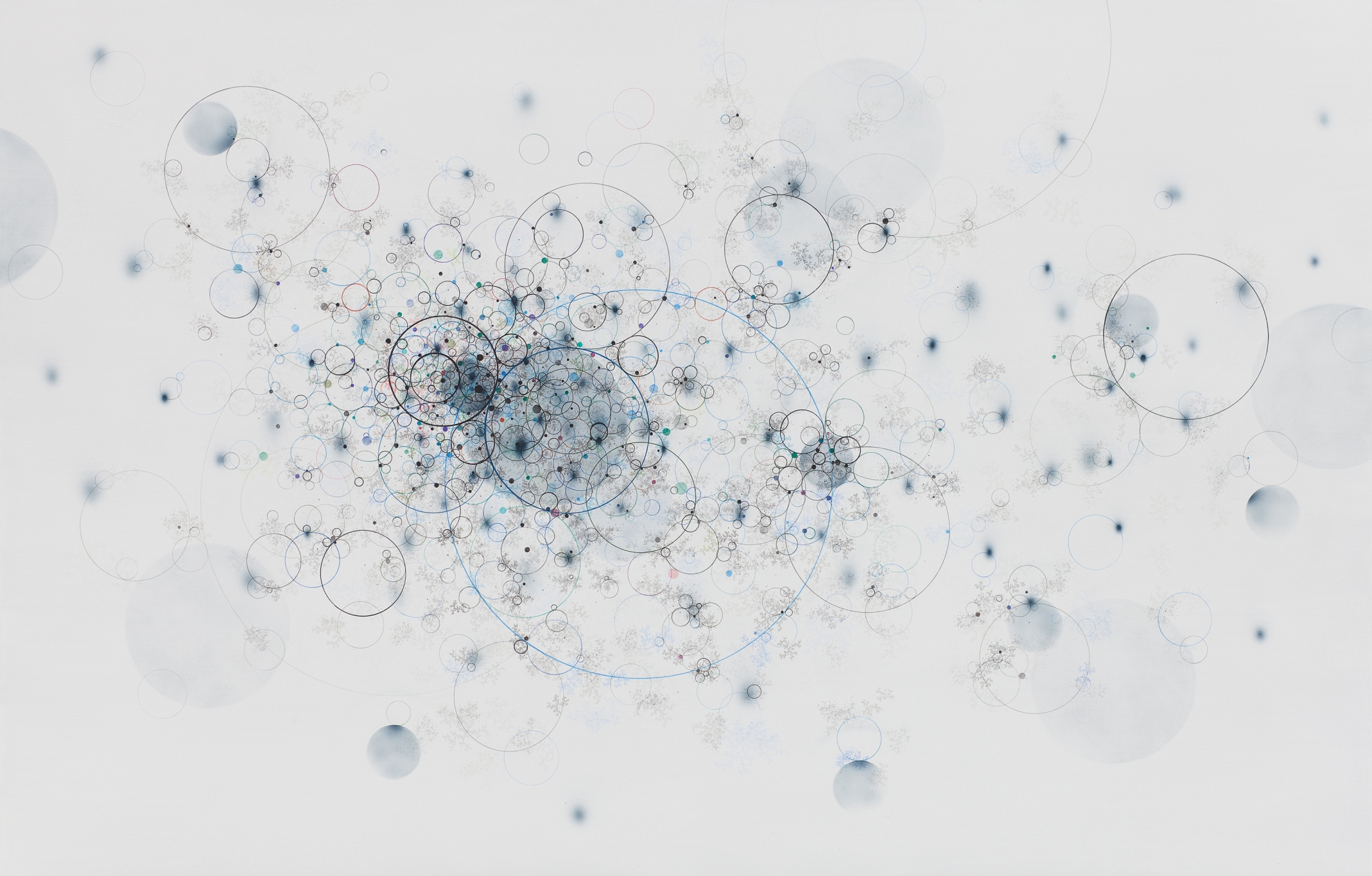
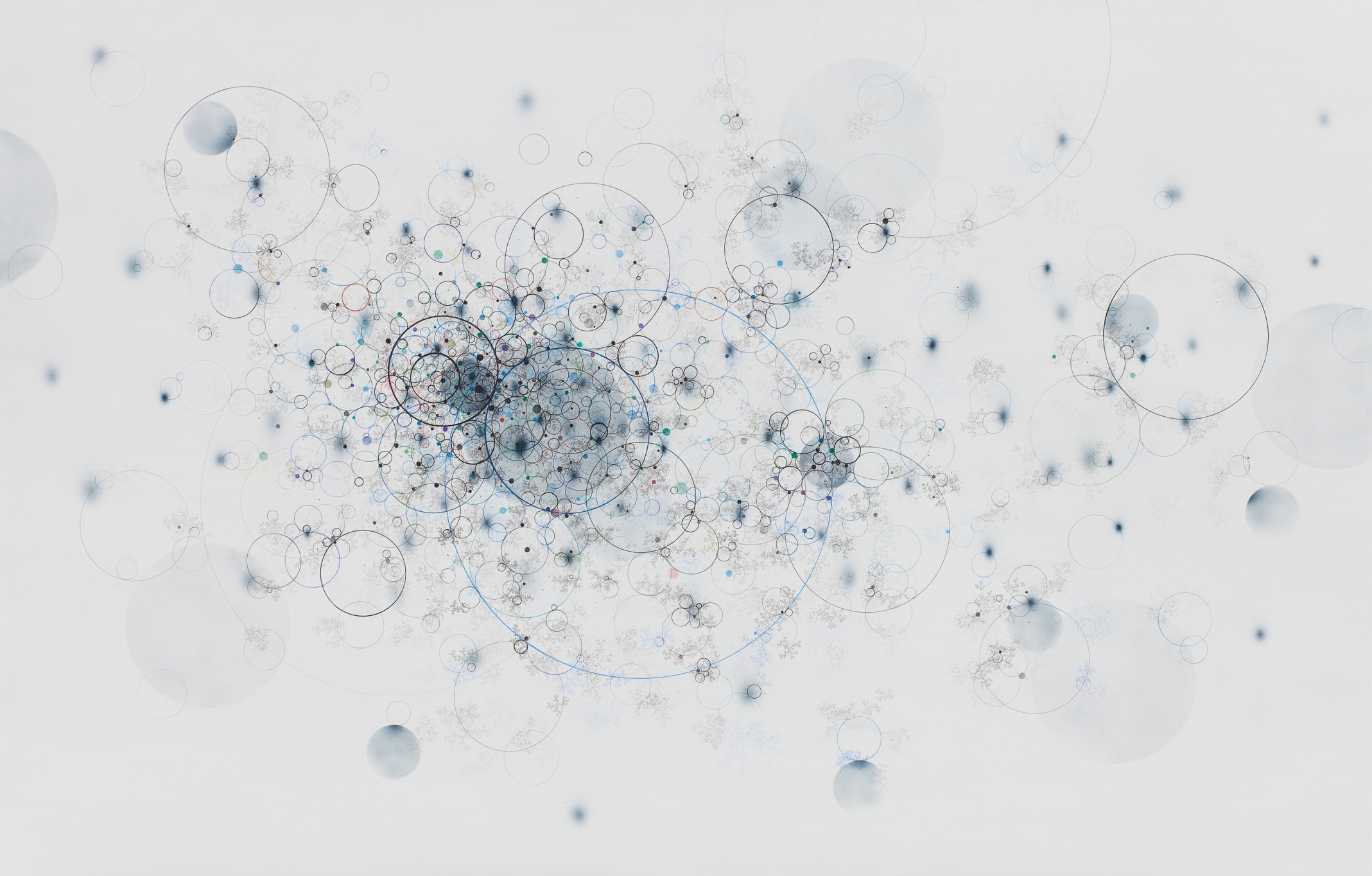
Untitled-15019, 2015, Mixed Media on Canvas, 160 x 260 cm ©Artist
Lee Kang Wook is a distinguished mid-career artist at the forefront of contemporary Korean abstract painting. For a quarter of a century, he has unveiled series after series of abstract works with enigmatic titles: ‘Invisible Space Image,’ ‘Geometric Form,’ ‘The Gesture,’ as well as numerous ‘Untitled’ works in the ‘Line’ series. His art welcomes the viewer with deceptive accessibility. The recurring compositions, forms, and patterns—coupled with meticulously inscribed lines and tones that evoke the craftsmanship of metalwork—create an initial impression of warmth and softness.
But this inviting facade soon dissolves into beautiful confusion. The viewer is unable to locate the work’s entrance or exit, beginning or end. While Lee’s rigorous intellect and meticulous construction are evident, the guiding principles, conceptual underpinnings, and ultimate destination remain elusive. The experience is akin to entering a luminous, elegant passageway, only to find oneself in an infinite maze—aesthetically captivating yet gloriously disorienting.
Let us take a step back and reflect: what does the canvas mean to Lee, the painter? He does not begin with the tangible spaces and objects of reality, nor with color, light, phenomena, or movement. His own feelings, emotions, fantasies, or desires are also peripheral to his concerns. Instead, his gaze is directed toward invisible dimensions—realms beyond immediacy, unseen structures hidden in the depths of the immediate. But for Lee, these dimensions and structures are not singular entities to be found in one place. Rather, they exist in a state of fracture, divided into sharply opposed polarities. It is this division that gives rise to the artist’s dual vision, his multilayered approach to creation.
It is well known that Lee has been exploring the smallest dimensions of matter and life since his mid-twenties. Early in his artistic journey, he depicted invisible molecular and particle structures, platelets, and cellular forms on his canvas. Rather than simply replicating these elements, he used his unique expressive techniques to transform them into painterly “building blocks” or “leading motifs.”
Yet, as Lee carefully addresses these microscopic dimensions and structures, he also contemplates the infinite and the holistic. His gaze embraces, affirms, and observes both the smallest and the most sublime. His eyes and hands move with a clear conviction—a belief that only through the most insignificant elements can the grandest and most sublime be realized and concretized.
This belief, viewed through the lens of intellectual history, resonates with the profound proposition of the Renaissance thinker Cusanus: the “coincidentia oppositorum,” or the coincidence of opposites. This concept suggests that opposing elements are not mutually exclusive, but can coexist, connect, and find harmony. The remarkable philosopher G.W. Leibniz extended this principle to the entire cosmos, introducing the concept of the “monad.” Leibniz believed that the universe was filled with fundamental substances—invisible like microorganisms, yet alive—which he called monads.
Lee’s work shows a deep affinity with the concept of monads in multiple dimensions. One could say that for Lee, the canvas becomes a laboratory for “painterly monads.” His artistic journey is a continuous effort to conceive and manifest the monads of the entire universe. Through painterly elements, materials, and techniques, Lee sensually shapes and expresses the “primordial individuals” of matter and life, along with the waves and movements that occur between them.
Approaching Lee’s work through the lens of painterly monad creation answers several intriguing questions. First, it allows us to see more clearly the connections between his expanding series: ‘Line,’ ‘Untitled,’ ‘Invisible Space,’ ‘Geometric Form,’ and ‘Gesture.’ The changes and continuities within these series are not arbitrary choices or accidental overlaps. Rather, they reflect the evolutionary process of the artist’s intense conceptualization and experimentation with the painterly monad.
Like all evolution, Lee’s work involves not only vertical progression and leaps but also horizontal coexistence, connection, and expansion. What is most striking is the direction of this evolution. His painterly monads have moved toward a clearer awareness and visualization of the macroscopic dimension and the artist’s own bodily elements, which once receded like background music. Here, visualization should not be limited to mere perception through the eyes.
Just as monads are the source of all cosmic matter and life phenomena, the painterly monads Lee seeks to manifest encompass not only visible forms and structures but also the sensory relationships and communication possibilities between them. Because his painterly monad serves as a living, primordial entity within an infinite universe, it has continuously evolved and will continue to do so in the future.
Second, in considering the painterly monad, it becomes clear that Lee’s work has always been directed toward the very essence of painting itself. His practice seeks to restore painting in its most fundamental sense. This is an inescapable conclusion, for the question of how painterly monads are possible inevitably leads to a primordial consideration of what the canvas space today—no, what painting itself—really is, and to what extent it can encompass human aesthetic perception and practice.
How has the artist sustained such a profound and monumental contemplation over time? How has he continually translated this reflection into new forms? Perhaps it is due to two core convictions: first, the belief that painting can still fundamentally reinvent itself; second, the belief that opposing elements—microscopic structures and the macroscopic cosmos, stillness and movement, moment and duration, body and trace—can find harmony on the canvas and be recreated through painterly form. These two convictions, rare among contemporary artists, have always fueled the artist with intellectual vitality and creative passion.
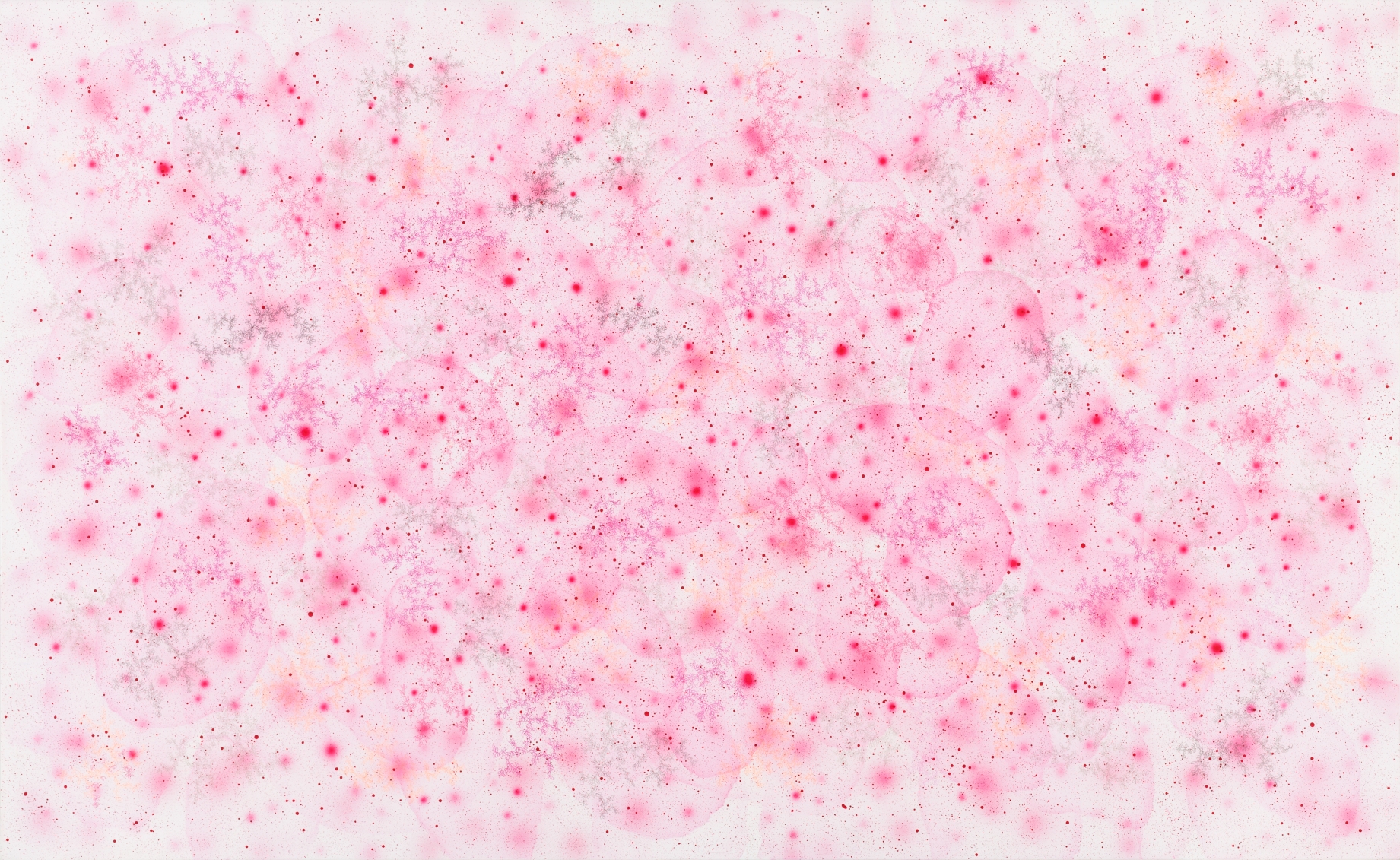
Through the concept of painterly monads, we can more precisely illuminate the sensory essence of Lee’s work. Unlike Leibniz’s monads, those that Lee seeks to manifest are sensual, concrete, and figurative. However, they do not resolve into a single, specific form. In keeping with the core concept of each series and his handling of painterly elements and materials, they appear as self-proliferating dots and lines, basic forms that generate repetition and difference, or color patterns marked by waves and transformations.
Even within works of the same series, the primordial plurality and diversity of monads is evident. A monad is unique and singular, but in its connection and exchange between the microscopic and infinite dimensions of all things, every monad is equal. This is a crucial difference from Leibniz. Lee’s painterly monads possess “windows” that allow them to empathize and communicate with other monads from the very beginning.
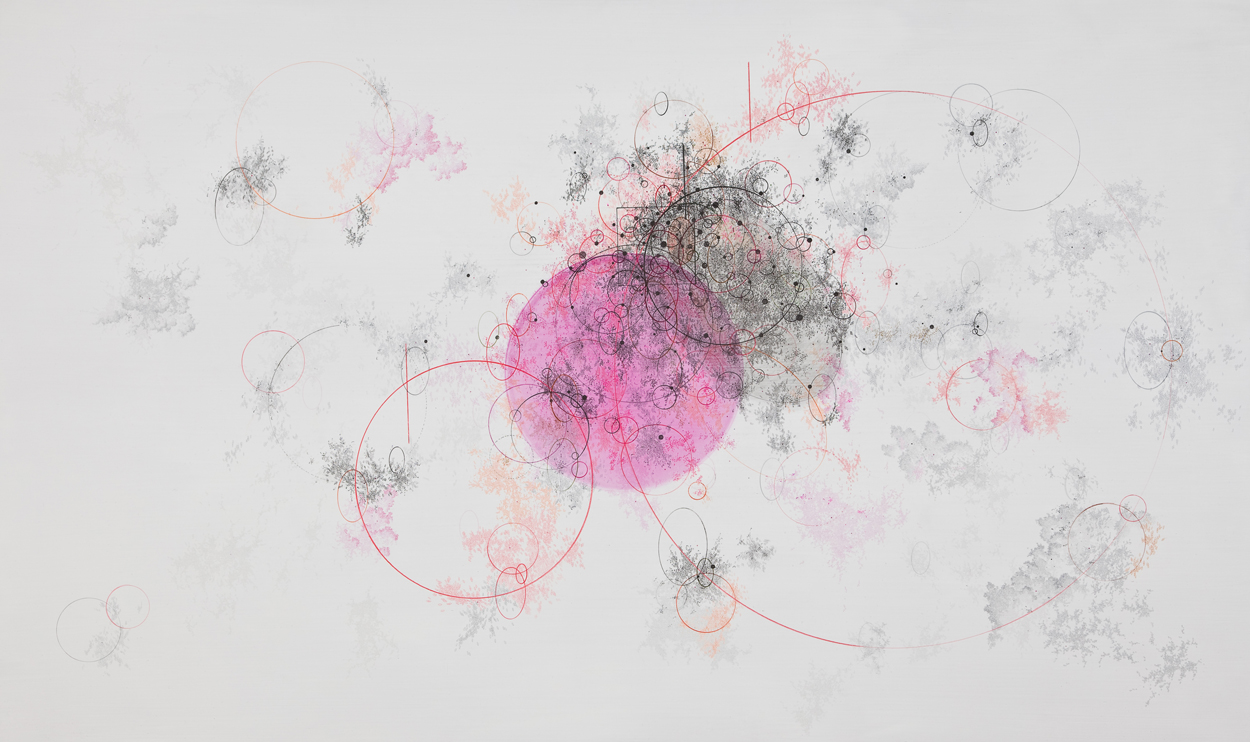
While Leibniz, obsessed with indestructible singularity, remained within the metaphysical concept of “substance,” Lee imagines monads that resonate and communicate through the productive complexity, ambiguity, and diffusion of sensation. When Lee places dots and draws lines on his limitless canvas, these marks, though not yet fully formed, already evoke other dots and lines. This does not suggest a fixed constellation but rather the very nature of these marks as the “potentiality” of sensory resonance, interaction, and interpenetration. It is a monad that can resonate and communicate sensually without substance—a “monad of potentiality,” infinitely open in function.
When encountering Lee’s work, one must resist focusing solely on external forms or compositions. Instead, one should delicately perceive how minute elements connect, resonate, and disperse—how these interactions form waves of dynamic vectors, and the subtle shifts in light, shadow, and tone they produce. Moreover, one must sensitively feel how the microscopic and macroscopic cosmos coexist, opposing yet connecting, exchanging in ways that evoke the suggestive power of different rhythms, intensities, directions, and movements.
Focusing on the sensory nature of the painterly monad, one inevitably encounters the question of subjectivity. Like all art, painting is a cultural creation of humans, but it also has the power to shape humanity. Great works of art have played a crucial role in shaping and transforming subjectivity—our senses, perceptions, imaginations, and ways of thinking.
How does Lee’s work invite the subject’s body and mind into the game of virtual movements? The empathetic subject participates in the creation and resonance of monads that emerge, connect, and resonate in plural forms. This subject participates in a sensory realm that transcends the distinctions between the visible and the invisible, the micro and the macro. The subject becomes a nomadic traveler between monads, playfully identifying with the rhythms, intensities, and movements that unfold on the canvas.
However, because the connections and resonances between the monads occur within an almost imperceptible space of dots and lines—within a flow without substance or center—the subject becomes one who fully embraces the ambiguity and duality of sensation, emotion, and imagination. Yet the aesthetic agent cannot settle on any sudden form or meaning on the canvas, for the artist’s serious challenge to the infinite canvas, and above all his refusal to accept simplistic logic or shortcuts, rejects easy conclusions.
Lee’s work seems to say: “Trust the infinite canvas and carefully follow the creation and evolution of painterly monads. But never forget or abandon the vibrant freedom and creativity of your own senses, imagination, and thought—and the potential for equal empathy and communication that can unfold from them.”
Writings